M.D. Anderson Memorial, Federal Grounds Jackson, TN
The M.D. Anderson Memorial Commission honors Monroe Dunway Anderson, the visionary founder of the renowned M.D. Anderson Cancer Center in Houston, along with his business partners. These four over-life size relief portrait sculptures are mounted to each side of a large granite monolith The memorial is located on the grounds of the City of Jackson’s Federal Building in Jackson, Tennessee.
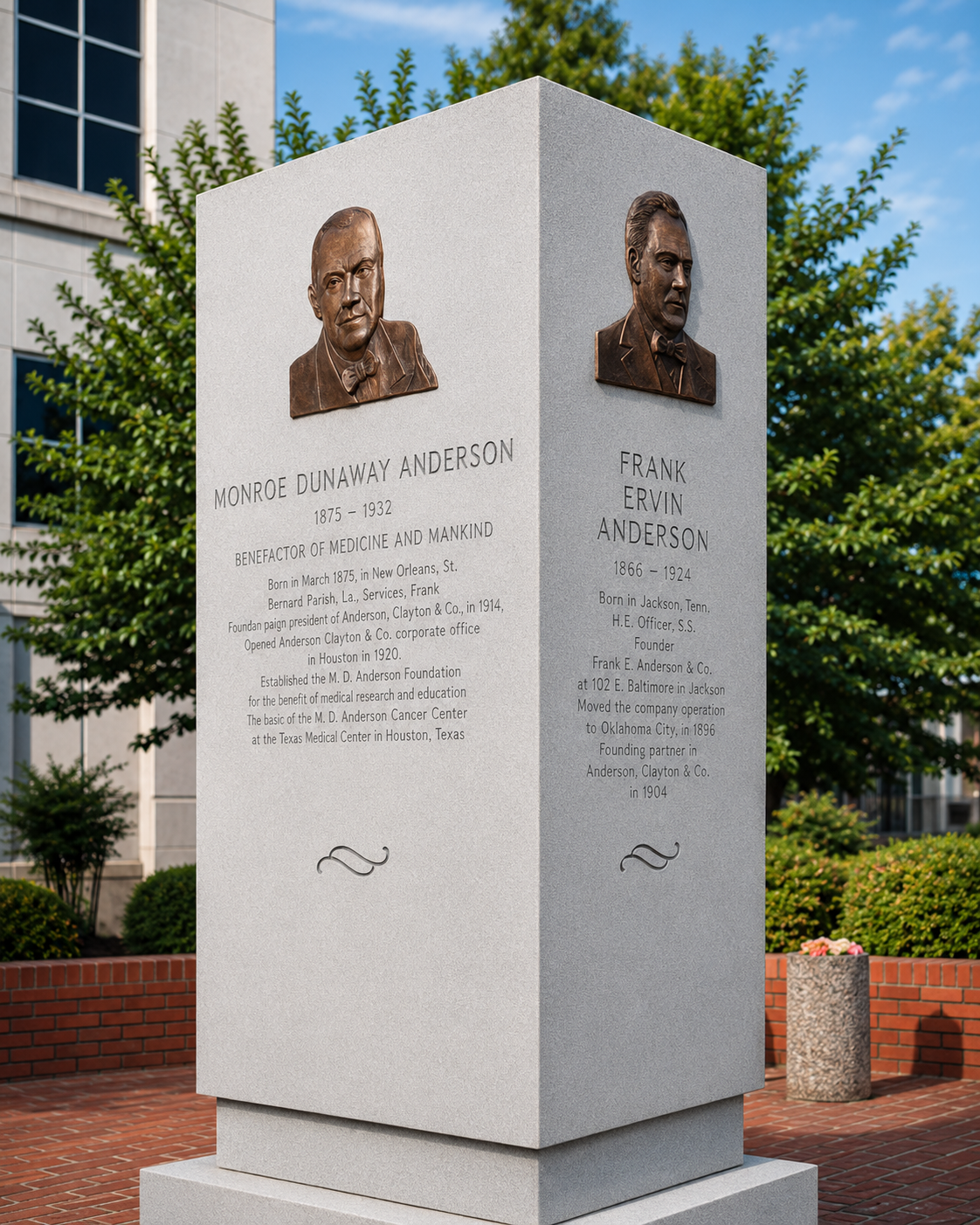
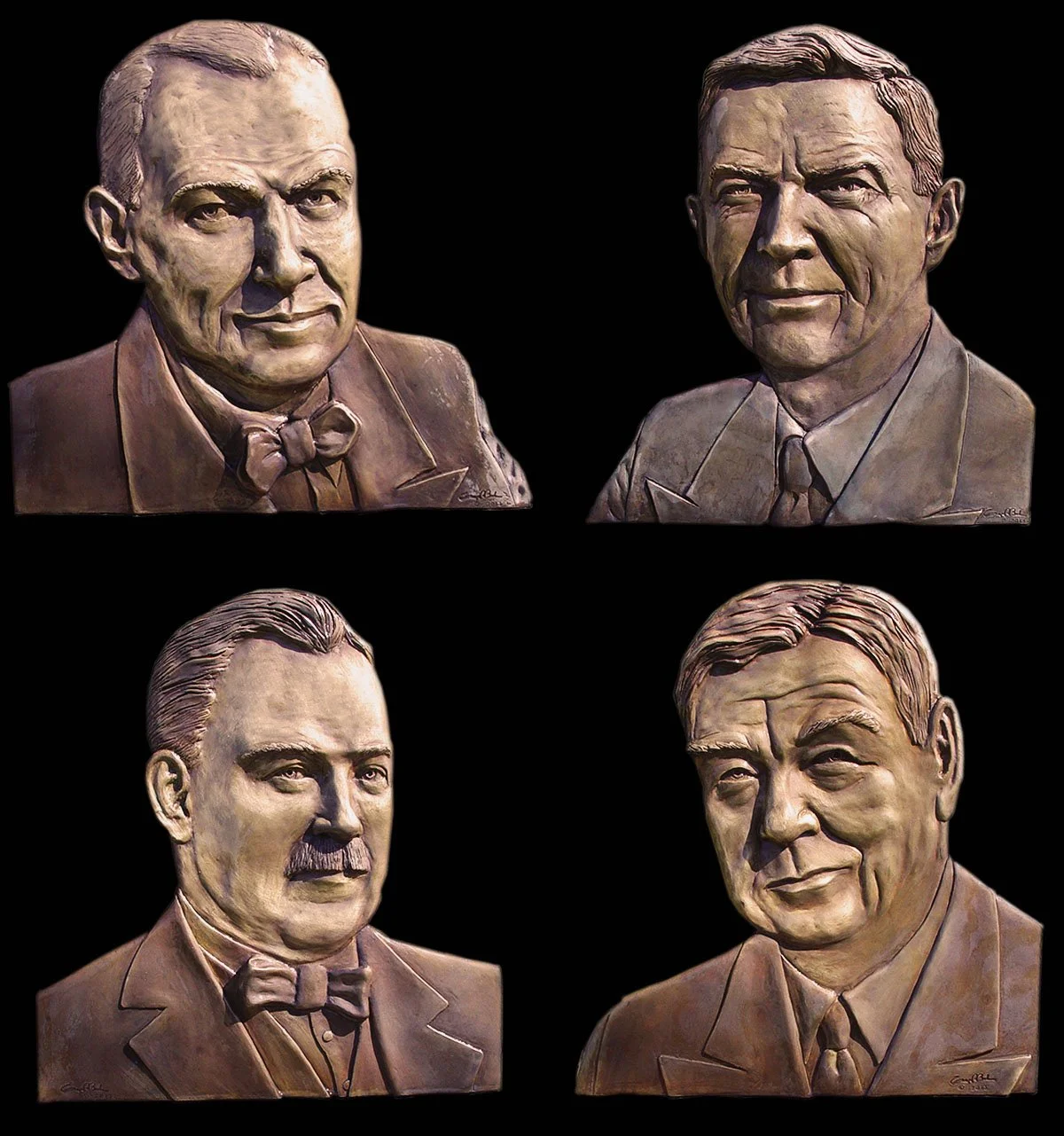
M.D. Anderson and the Beginnings of Anderson, Clayton & Co.
Long before the name M.D. Anderson became associated with one of the world’s leading cancer centers, Monroe Dunaway Anderson was a banker and businessman who helped build one of the most successful cotton companies of the early 20th century.
In 1904, M.D. Anderson joined his older brother, Frank Anderson, and Frank’s brother-in-law, William L. “Will” Clayton, in forming Anderson, Clayton & Company in Oklahoma City. Frank and Will brought experience and ambition in the cotton trade, while M.D. provided much-needed capital and financial expertise. The following year, Will’s younger brother, Benjamin “Ben” Clayton, joined the partnership, bringing valuable knowledge of railroad and steamship transportation. (Texas State Historical Association)
The four men proved to be a formidable team. M.D. Anderson concentrated on banking and finance, Frank Anderson on cotton merchandising, and the Clayton brothers helped develop the company’s purchasing, transportation and international distribution operations. In 1907, M.D. moved to Houston to take advantage of the city’s banking resources and its growing importance as a shipping center. The company followed, moving its headquarters to Houston in 1916 as the newly completed Houston Ship Channel opened greater access to world markets. (Texas State Historical Association)
Anderson, Clayton & Company grew rapidly, eventually becoming one of the world’s largest merchants of cotton, with operations extending across the United States and into international markets. The success of the company created the fortune that allowed M.D. Anderson to establish the M.D. Anderson Foundation in 1936. Following his death in 1939, much of his estate went to the foundation, whose philanthropy ultimately helped establish both the Texas Medical Center and the cancer institution that today bears his name. (UT MD Anderson)